On the vast network of transmission lines stretching across the country, a silent "war" is waged every day. Kite remnants, floating agricultural films, and dancing ribbons - these seemingly insignificant "trinkets" are actually the most dangerous "assassins" of the power grid. They silently attach themselves to the conductors, causing minor issues like line tripping or, in severe cases, conductor burnout and widespread power outages. According to operation and maintenance data, faults caused by foreign objects account for half of all line failures.

Why should we be so vigilant about a few grams of plastic film? Because high-voltage electricity shows no mercy. When plastic films get damp, their insulation resistance drops sharply, easily causing single-phase grounding. Tough kite strings, if left on the conductors for a long time and repeatedly whipped by the wind, can lead to conductor wear, strand breakage, and eventually line breakage. What's more, these foreign objects tend to "settle" in remote wilderness, steep slopes, or muddy fields - precisely the areas where heavy engineering vehicles dare not venture. In the past, to clear a single foreign object, operation and maintenance teams often had to drag dozens of kilograms of equipment through thorny bushes for hours, not only inefficient but also exposing the repair personnel to extremely high safety risks.
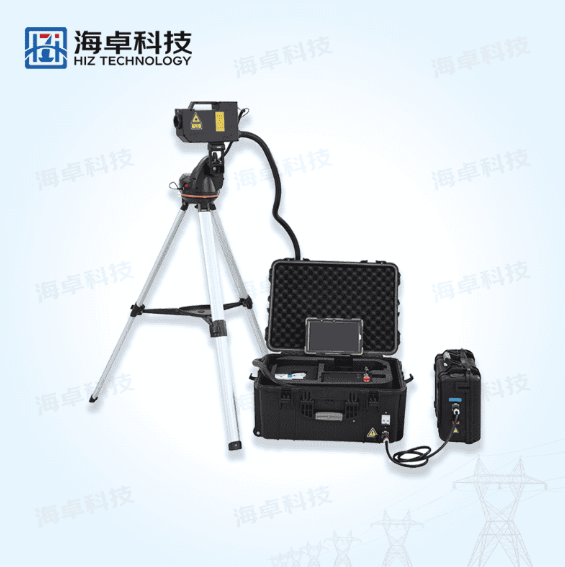
The HIZ-NT-QZY mobile laser obstacle removal device from Guangxi Haizhuo Technology Development Co., Ltd. has abandoned the bulky cabinets and complex brackets of traditional laser obstacle removal devices, replacing them with a modular integrated design. Carrying a box, it can be deployed as easily as a routine patrol.
Imagine this scenario: A 10kV line in a mountainous area is covered with plastic films due to strong winds. Traditionally, vehicles cannot reach the mountain, and the repair team would have to carry over a hundred pounds of equipment on foot for two hours. But now, with the HIZ-NT-QZY, operation and maintenance personnel can travel light and arrive at the scene in 20 minutes. Using the laser for remote "spot shooting," they can clear the foreign objects in just five minutes, all without the need to shut down the power line.