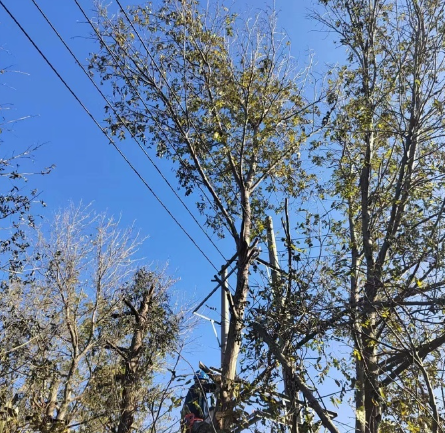
The trees in the mountain forests grow too tall and may come into contact with high-voltage transmission lines, which not only poses a simple physical contact issue but also may trigger various types of safety hazards, seriously affecting the stable operation of the transmission lines. Specifically, this mainly manifests in the following aspects:
1.It caused a short circuit trip in the line, resulting in a large-scale power outage.
There are strict industry standards for the safety distance of high-voltage transmission lines. Even if the branches do not directly touch the conductors, long-term proximity may cause interphase short circuits or single-phase grounding faults. Once the line protection device detects an anomaly, it will immediately trigger the tripping mechanism, resulting in power outages and affecting various power demands such as residents' lives, enterprise production, and traffic signals. Moreover, troubleshooting and power restoration take a considerable amount of time, and the impact range is wide.
2. Breakdown discharge occurs, causing electric shock and casualties.
Some people have a misconception that they are safe as long as they do not directly touch high-voltage wires. In fact, when the distance between trees and wires is insufficient, the air insulation layer can be broken through, resulting in arc discharge. If people are working, cutting or staying close to the trees, they may get an indirect electric shock through the trees; at the same time, step voltage may be generated, and even if they do not touch the trees, it may cause electric shock injuries to the human body and endanger life safety.
3. It is prone to causing forest fires, leading to major safety disasters.
This is one of the most serious threats posed by tree obstacles to high-voltage transmission lines. The high temperatures generated by electric arcs and discharges can quickly ignite dry leaves and dead branches in the forest, especially during dry seasons, when the fire spreads rapidly and is difficult to control. Fires not only damage the ecological environment but also further break the conductors and damage the transmission towers, causing power outages over a wider area and resulting in significant economic losses.
4. It leads to the wear and tear of line equipment and shortens the service life of the equipment.
Under the influence of wind force, trees will sway, and the branches will repeatedly rub and collide with high-voltage conductors, thereby causing damage to the insulation layer of overhead insulated lines, broken strands of conductors and fatigue damage. At the same time, it will also damage the line fittings, insulators and other accessory equipment. Although such damage is relatively minor at the initial stage, it will gradually intensify, significantly shortening the overall service life of the transmission line and laying hidden dangers for subsequent line faults.
5. Increase the risk of lightning strikes and pollution flashovers, raising the probability of line faults.
Tall trees can alter the distribution of the surrounding electric field, making them more likely to be struck by lightning and increasing the probability of lightning strikes on power lines. At the same time, leaves, dust and other debris are prone to adhering to the surface of insulators, reducing their insulation performance. This not only raises the probability of lightning-induced tripping but may also cause pollution flashover tripping, leading to frequent line faults and increasing the workload of maintenance for power departments.
6. Obstructing emergency repairs and exacerbating secondary safety risks
The mountainous and forested areas are densely covered with trees, which seriously hinders the passage of maintenance vehicles and the operation of maintenance personnel. As a result, when a line fault occurs, maintenance personnel cannot reach the fault point in time to carry out handling work, prolonging the power outage time. In addition, the dense tree environment also increases secondary risks such as secondary electric shock, falling from heights, and fire spread during the repair process, threatening the personal safety of maintenance personnel.
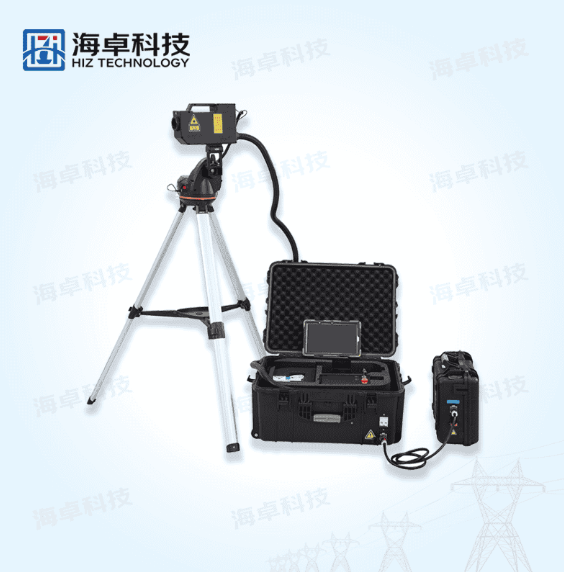
If trees are found to be in close proximity to high-voltage transmission lines in mountain forests, the power department should be contacted promptly for handling to prevent potential hazards from escalating and causing safety incidents. With the support of modern technology, the removal of tree obstacles is no longer as complicated as traditional methods. For instance, the HIZ-NT-QZY laser tree obstacle removal device from Guangxi Hai Zhuo Technology can be used. It is controlled by a wireless controller to emit a controllable laser from the ground to remotely cut and remove high-altitude obstructions. It is equipped with a focusable machine vision magnification system, allowing for a clearance distance of up to 300 meters.