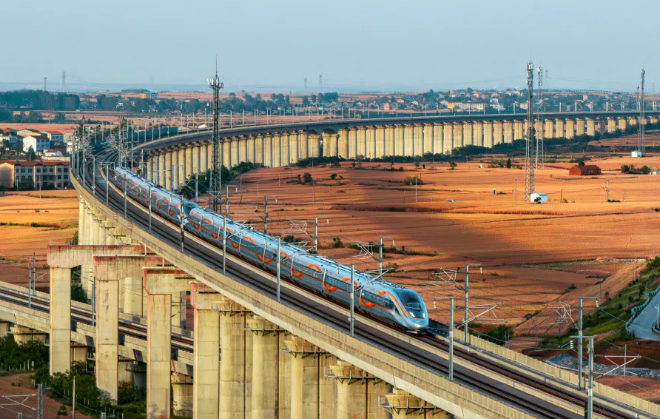
The railway catenary, as the "power source" of EMUs, directly determines the order of railway transportation. But what if light and floating foreign objects suddenly appear?
Plastic films, kites, and sky lanterns are easily blown onto the catenary by strong winds, which may cause short circuits, train bow lowering and speed reduction, or even stoppage, seriously affecting the safety and efficiency of railway operations. In the past, dealing with such hazards required line closures and maintenance personnel to perform high-altitude operations, a process that could take up to half an hour. This not only disrupted normal train operations but also posed safety risks to the workers.
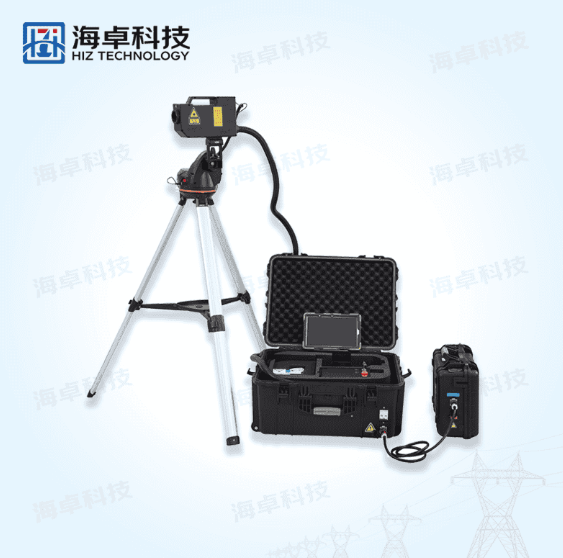
Hizotech has introduced the HIZ-NT-QZY portable laser obstacle removal device for railway catenary, which redefines the catenary obstacle removal mode with non-contact laser technology. It enables efficient maintenance without stopping trains, using ladders, or disrupting the lines, reducing the time for removing a single obstacle from half an hour to just five minutes, significantly enhancing the emergency response capability of railway catenary.
The core advantages of the portable laser obstacle removal device for railway catenary lie in its efficiency and safety, perfectly meeting the needs of railway catenary maintenance scenarios. It uses high-energy laser remote obstacle removal technology, relying on the thermal effect of specific wavelength lasers to precisely ablate and vaporize light and floating foreign objects. It can also penetrate the metal catenary wires without damaging the line itself, achieving a high success rate in removal. Maintenance personnel do not need to enter the line area; they can complete aiming and operation from the outside of the track, completely eliminating the cumbersome process of line closures and manual high-altitude operations, and avoiding problems such as train delays and transportation disruptions caused by line closures.
As a portable device, its lightweight and modular design greatly enhances scene adaptability. A single person can complete the setup and operation without complex auxiliary equipment. Even in areas where track operation vehicles are difficult to access, such as mountainous regions, it can be flexibly deployed for operations. Compared with traditional obstacle removal methods, this device not only increases the operation efficiency by more than 80%, but also completely eliminates the safety risks of maintenance personnel performing high-altitude operations and coming into contact with high-voltage lines, promoting the transformation of railway catenary obstacle removal from "passive repair" to "active and efficient handling".